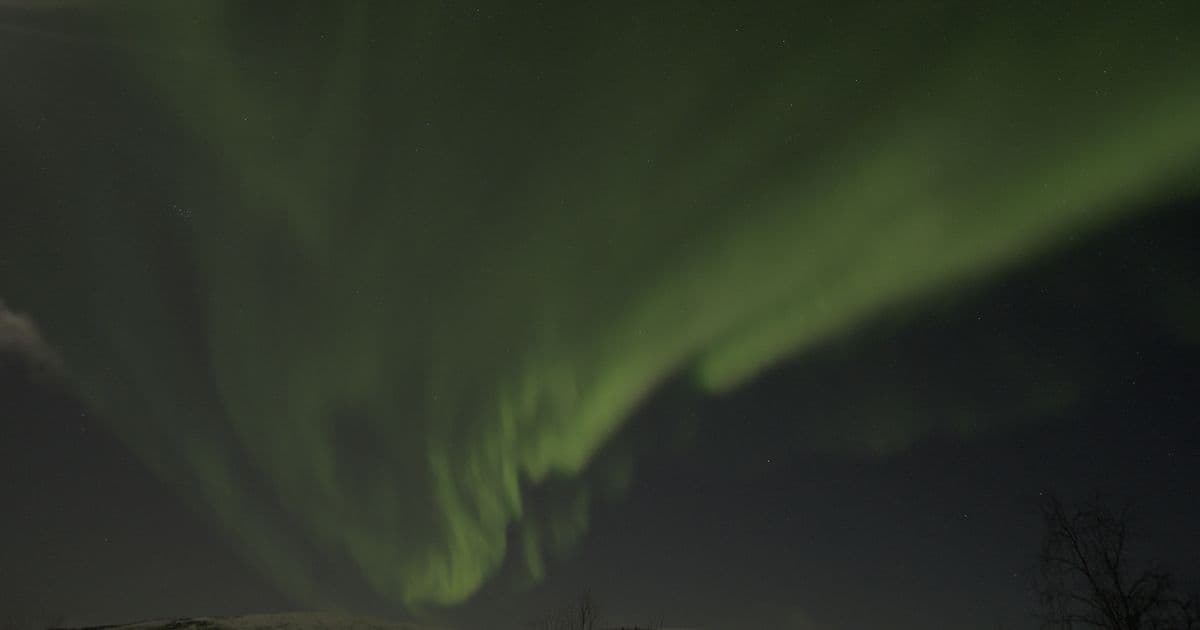
You have a four-month window for the northern lights in Sweden, and no single source ranks it for you. December, January, February and March each get called the best month somewhere online, and the pages rarely explain why they disagree. This guide gives you the daylight hours, the clear-sky mechanics and the 2026 solar-cycle context for each month. Every figure is dated and sourced, so you can decide which month fits your trip instead of guessing from an adjective.
Month-by-month at a glance. Daylight is sunrise to sunset for Kiruna (67.86°N, 20.23°E) from the US Naval Observatory; temperatures are the 1991–2020 monthly normals for Kiruna Flygplats, computed from SMHI's own observation archive. Both are averages: a single night can sit far below the monthly normal.
| Month | Daylight in Kiruna (USNO) | Monthly normal, 1991–2020 (SMHI) |
|---|
| December | Polar night from 11 December; about 5.5 hours of civil twilight around midday at the solstice | About −9°C |
| January | About 36 minutes on 2 January, rising to roughly 5 hours 45 minutes by the 31st | About −11°C |
| February | Roughly 6 hours to 9.5 hours | About −11°C |
| March | Just under 10 hours to close to 14 hours | About −7°C |
Jump to: Peak Season · December · January · February · March · Abisko · Nightly Window & Solar Cycle · Common Questions
Peak Season Runs December Through March, but the Odds Shift Within It
Three reputable sources give three different windows for the same season. Nordic Visitor names December through March as peak season, updated 24 September 2025. The Swedish Tourist Association (STF) narrows the window further: "The best time to see the northern lights is from mid-November to mid-March." Visit Sweden goes further still and names January specifically as Arctic Sweden's peak viewing month.
The three do not actually contradict each other; they answer slightly different questions. STF is being conservative about when real darkness exists at all. Visit Sweden is naming one peak month inside that darkness, not the whole usable range. Nordic Visitor gives the practical booking range most trip planners use. If you are picking a month by darkness alone, December looks like the obvious choice. Darkest does not equal best odds, since December's polar night includes only a few hours of usable twilight per day, and cloud cover still decides every individual night regardless of the calendar.
December, the Darkest Month, Only Pays Off With a Clear-Sky Plan
The almanac settles this one. Kiruna's last sunrise of the year is 10 December 2026, when the sun clears the horizon at 11:16 and sets again at 11:47, a window of 31 minutes. From 11 December the US Naval Observatory records the sun as "continuously below the Horizon," and it stays there until the next sunrise on 2 January 2027. That is 22 days of polar night, not the "about 28 days" Kiruna Lappland estimates without giving dates.
Polar night on the ground is not total black. On the solstice the sun still lifts close enough to the horizon to give Kiruna civil twilight from 08:56 to 14:18, about five and a half hours of usable light with no sunrise in it (US Naval Observatory). Long nights alone do not guarantee a sighting. A cloudy December night in Kiruna gives you the same nothing a cloudy night gives you anywhere else; the darkness only helps once the sky is clear enough to see through it.
January, Daylight Returns Fast, and Arctic Sweden Hits Its Peak
Visit Sweden names January the peak viewing month for Arctic Sweden, even as daylight is only beginning to return. Daylight climbs fast: 36 minutes on 2 January, 3 hours 18 minutes by the 15th, and 5 hours 46 minutes on the 31st (US Naval Observatory). January is also Kiruna's coldest month, with a 1991–2020 normal of about −11°C at Kiruna Flygplats computed from SMHI's observation archive. That is the month's average, not its floor; a cold spell can sit twenty degrees below it, which affects how you pack far more than it affects viewing odds.
The combination is what makes January stand out: nights are still long enough for a wide viewing window, but the darkest weeks of polar night have already passed. That leaves more evening hours where twilight has faded fully to dark, without losing the depth of darkness December still carries into its final days.
February, More Daylight, Still Enough Darkness, and the Season Fills Up
February runs from 5 hours 54 minutes of daylight on the 1st to 9 hours 38 minutes on the 28th (US Naval Observatory), leaving nights still long enough for viewing. The month's 1991–2020 normal at Kiruna Flygplats is about −11°C, essentially level with January rather than milder than it, on SMHI figures. February's advantage over January is the extra daylight for everything you do before dark, not warmth.
Ski resorts open alongside the aurora season through February, a practical branch if you are combining the two on one trip. STF's Aurora Sky Station remains in operation through this stretch as well, so the infrastructure built around viewing does not disappear once the darkest weeks end. Bookings tend to fill faster in February than in December, since the longer days let a visitor fit a full daytime activity and a night of viewing into the same twenty-four hours.
March, the Mildest of the Four Months, and the Locals' Pick
Kiruna Lappland calls March "a great month for exploring the northern lights, as temperatures are a little bit nicer than in January and February," and SMHI bears that out: March's 1991–2020 normal at Kiruna Flygplats is about −7°C, some four degrees above January and February. Daylight runs from 9 hours 46 minutes on 1 March to 13 hours 41 minutes on the 31st (US Naval Observatory). Swedish Lapland separately describes February through March as offering longer days while conditions stay snowy across the region.
The trade-off is straightforward: more daylight means a shorter nightly viewing window than December or January give you, balanced against noticeably milder temperatures for the hours you do spend outside. If your priority is comfort over maximum darkness, March gives you the best terms of the four months. If your priority is the longest possible dark window each night, March is the weakest of the four.
Why Abisko Clears When the Rest of the Sky Does Not
Abisko sits in a rain shadow, a mechanism that operates independently of which month you visit. Off the Map Travel, a tour operator rather than a meteorological body, puts the cleared patch at "approximately 10-20 square kilometers." No authority publishes a measured area for it, so read that as the operator's estimate of an effect that is real, not as a surveyed number. Visit Sweden's own page on the area confirms Abisko holds clear skies even when nearby regions stay cloudy. Nordic Visitor notes Abisko's low precipitation as a structural advantage over the wider region, not a seasonal one.
Swedish Lapland records stretches of sometimes more than two weeks of consecutive northern-lights-viewing nights in Abisko, a pattern the rain shadow explains better than the calendar does. If you are choosing between two destinations at the same latitude, Abisko's geography gives it an edge that no single month can replicate elsewhere. For context on how this fits the wider region, see where to go in the north, including Kiruna and Abisko.
The Nightly Window, and What Solar Cycle 25's 2026 Decline Means for the Odds
Sightings cluster inside a nightly window that sources place between roughly 6 p.m. and 2 a.m., with peak activity around 9–11 p.m. Visit Sweden, IceHotel, Swedish Lapland and Nordic Visitor each give slightly different edges to that range, but all four sources place the most active hours in the same three-hour band.
Solar Cycle 25 peaked at a 13-month smoothed sunspot number of 160.9 in October 2024, the highest value in SILSO's smoothed monthly series. Its yearly means then fall from 154.7 in 2024 to 123.2 in 2025. SILSO, the World Data Center for the sunspot index at the Royal Observatory of Belgium, is the body that produces those numbers. The decline means fewer geomagnetic storms are expected through 2026 than in 2024, not none. Nordic Visitor notes that sightings from Stockholm are possible but rare, and the odds favor heading north regardless of month or solar-cycle stage. For a plan that accounts for both, see planning a Sweden trip around the season.
Common Questions About Sweden's Northern Lights Season
Is the polar night itself dark enough for viewing, or does daytime twilight interfere?
It is dark enough. Kiruna's brightest stretch during polar night is civil twilight, which on the solstice runs 08:56 to 14:18 (US Naval Observatory). That light sits entirely in the middle of the day and is gone well before the usual evening viewing hours, so it does not cut into your window.
Can the northern lights be seen from Stockholm during the December–March window?
Nordic Visitor calls sightings from Stockholm "possible but rare," and recommends heading north for meaningfully better odds. If your trip only allows a stop in Stockholm, treat any sighting there as a bonus rather than the plan.
Does Solar Cycle 25's decline into 2026 lower the odds versus 2024?
SILSO puts the yearly mean sunspot number at 154.7 for 2024 and 123.2 for 2025, so fewer storms are expected in 2026 than at the 2024 peak. That is a statement about the year, not about any month inside it. No authority publishes a per-month probability of seeing the aurora from a given place, so no single month in this window is guaranteed better odds than another on solar-cycle grounds alone.
January Peaks the Odds, but Abisko's Sky Matters More Than the Calendar
The peak window runs December through March. December carries the darkest nights but the least usable twilight, January is the month Visit Sweden names as Arctic Sweden's actual peak, and February and March trade some darkness for considerably more daylight, with only March also bringing milder air. Abisko's rain-shadow mechanism matters more than any single month, since it clears a patch of sky the calendar cannot touch. Solar Cycle 25 has passed its 2024 peak, but it remains active enough through 2026 that no month in this window is a poor choice. For the wider picture across the year, see the season-by-season darkness and light guide, part of Sweden Unpacked's coverage of visiting Sweden.