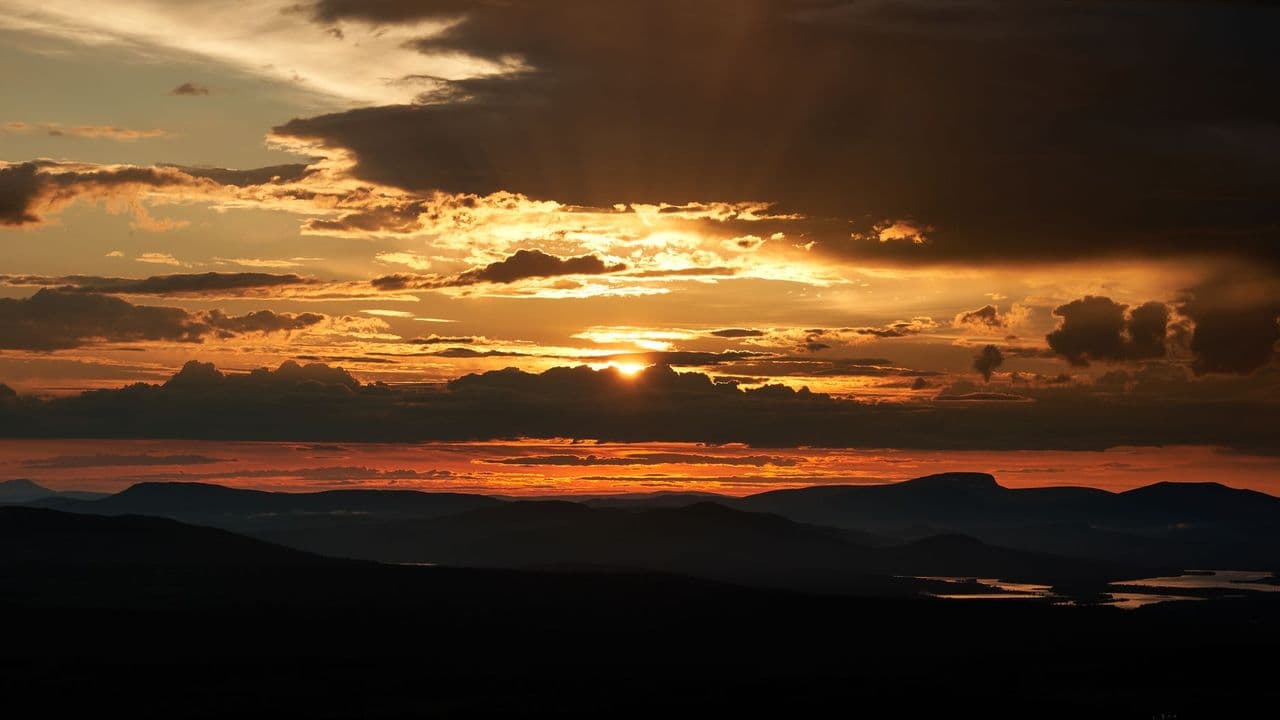
In Kiruna, the sun stays above the horizon for 47 straight days, per SMHI. Stockholm, farther south, never reaches that phenomenon at all. Both are Sweden. The difference comes down to latitude, and the exact window shifts by town.
This guide gives the dated ranges for Abisko, Kiruna, Gällivare and Jokkmokk. It also marks the line where true midnight sun ends and Sweden's white nights begin.
What Counts as Midnight Sun, and Where the Line Falls
Midnight sun means the sun never dips below the horizon for a full 24 hours. In Sweden, that only happens north of the Arctic Circle, at about 66.5°N, per SMHI. SMHI does not give a more precise arcminute figure for the boundary.
Stockholm sits at about 59°N, per A Day in Stockholm. That is well south of the Arctic Circle threshold, so Stockholm never gets true midnight sun, regardless of the time of year.
Midnight Sun Dates by Town
The window runs roughly from late May to mid-July, but the exact start and end date shifts by town. The farther north a town sits, the longer its window runs.
Abisko's midnight sun runs from 25 May to 18 July, per Visit Sweden. The Swedish Tourist Association gives a nearly identical window, 25 May to 17 July.
Kiruna's window runs from 28 May to 14 July, confirmed by both Visit Sweden and the Swedish Tourist Association.
Gällivare's window, per Visit Sweden, runs from 2 June to 10 July. The Swedish Tourist Association gives 3 June to 9 July. Gällivare's own tourism office gives no exact dates. It only describes the season as running from the start of June to the start of July.
Jokkmokk's window, per Visit Sweden, runs from 5 June to 7 July. The Swedish Tourist Association gives 8 June to 4 July. That is three days later at the start and three days earlier at the end, a three-day-narrower window.
How Long It Actually Lasts in Kiruna
Kiruna gets 47 days of true midnight sun, per SMHI. "Solen är alltså uppe 47 dygn i sträck," SMHI states, meaning the sun stays up 47 days in a row.
That 47-day span sits inside a longer stretch. During it, the sky never goes fully dark. Kiruna Lappland puts that wider, nightless period at around 100 days.
The two figures measure different things. Forty-seven days count the sun literally above the horizon. The roughly 100-day span counts every night that never turns fully dark. That includes the weeks before and after the sun stays up around the clock.
Visit Sweden says some locations in Arctic Sweden reach up to 56 days of midnight sun straight.
Stockholm Sits South of Sweden's White-Nights Zone
South of the Arctic Circle, the sun sets every night in June, including in Stockholm. But the sky does not go fully dark everywhere south of that line either.
SMHI marks three stages of twilight by how far the sun sits below the horizon. Civil twilight starts at 6°, nautical at 12°, and astronomical at 18°, per SMHI.
The zone that stays within civil twilight all night runs "ungefär från Dalälven och norrut," per SMHI. That means roughly from the Dalälven river northward, about 60.5°N and up.
Stockholm sits at about 59°N, south of that line. Around the summer solstice, its night sky sinks past civil twilight into the darker nautical range. It does not stay in the bright white-nights band the far north gets.
Sunset falls near 10 pm and sunrise near 3 am around the solstice, per A Day in Stockholm.
Seasonal light in Sweden extends well beyond the few weeks around the solstice. For the broader pattern, see Seasons, Darkness & Light.
Planning Around It
The midnight sun window overlaps Midsummer, Sweden's biggest summer holiday. Midsummer Day, midsommardagen, is legally the Saturday between 20 and 26 June, per Lag (1989:253). That date falls inside the midnight sun window in all four towns above.
Midsummer Eve, the customary Friday before midsommardagen, is not itself fixed in the statute. It still falls inside each town's window, since Midsummer Day always does and Eve sits only one day earlier.
Constant daylight suits activities like hiking, boating and cycling, since there is no darkness cutting the day short. It also disrupts sleep, since the body still needs a dark period even though the sky does not provide one. Visit Sweden and Kiruna Lappland both recommend packing a sleeping mask for a trip during the window.
Once the dates for a specific town are set, the next step is to build a trip around Sweden's daylight calendar. Seeing where Swedish Lapland fits into a wider Sweden trip helps with routing beyond the far north.
Frequently Asked Questions
Can you see the midnight sun in Stockholm?
No. Stockholm sits at about 59°N, per A Day in Stockholm. That is well south of the Arctic Circle threshold of roughly 66.5°N, per SMHI. It also sits south of the zone that stays within civil twilight all night, per SMHI. Its solstice nights reach the darker nautical range instead.
What dates can you see the midnight sun in Abisko?
Abisko's midnight sun runs from 25 May to 18 July, per Visit Sweden.
How many days of true midnight sun can you get in Kiruna?
Kiruna gets 47 days of true midnight sun, per SMHI, inside a roughly 100-day span without full night, per Kiruna Lappland.
Does Midsummer fall inside the midnight sun window when you visit?
Yes. Midsummer Day is legally the Saturday between 20 and 26 June, per Lag (1989:253). That date falls inside both Kiruna's window, 28 May to 14 July, and Abisko's, 25 May to 18 July.
Conclusion
Midnight sun in Sweden is a narrow, dated phenomenon, not a description of the whole country's summer nights. It only happens north of the Arctic Circle, at about 66.5°N, per SMHI. Kiruna's window runs 28 May to 14 July, with 47 days of the sun never setting. Abisko's window opens a few days earlier and closes a few days later, 25 May to 18 July. Stockholm, at about 59°N, sits south of the Arctic Circle and south of the zone that stays lit in civil twilight overnight. So its June nights never reach either phenomenon.
A two-week difference in travel dates can mean the gap between full midnight sun and a merely bright night. Checking the exact window for the specific town on the itinerary, rather than the country as a whole, is what settles that. For planning a visit to Sweden around any season, matching the trip to the daylight calendar for that specific place and month makes the difference.