The information here is for general informational purposes only and does not constitute legal, financial, or tax advice. Always consult a qualified professional for your specific situation.
Sweden does not run on a single national transport network. It runs on a patchwork of county-level authorities that generally do not share ticketing with each other or with SJ's national trains. The practical question for a trip without a car is not whether Sweden "has" public transport. It is which region the trip covers, and which operator runs that region's trains, buses, or boats.
Some parts of the country run on dense, frequent rail. Others depend on a single bus line or one ferry crossing a day. One far-north route lost half its night-train frequency in April 2026, with a new operating contract still unsettled. This guide answers the question region by region, naming the operator and any current schedule constraint for each.
See the site's guide to planning the rest of the trip for the season and booking-window decisions that sit alongside the transport question below.
Region
How it is reached
Operator of record
Car needed?
Skåne and central Sweden
Regional rail, hourly on busiest corridors
Skånetrafiken, Västtrafik
No
Stockholm archipelago
Ferry
Waxholmsbolaget
No
Gotland
Single ferry crossing
Destination Gotland
No
Norrland coast (Luleå–Boden–Kiruna)
Day train
Norrtåg
No
Far north (Stockholm–Narvik/Umeå)
Overnight train, reduced to one daily round trip since April 2026
SJ (direct-award, under Trafikverket)
Optional, but plan around the reduced schedule
How Sweden's Regional Transport System Is Divided
Sweden's public transport is organized by county-level authorities, including Skånetrafiken, Västtrafik, SL, and Länstrafiken Norrbotten. A ticket bought for one county typically does not carry onto SJ's national trains or into a neighboring county's network. A trip that crosses a county line usually means buying a second ticket, even when the journey feels continuous to the traveler.
Three layers make up the system. SJ operates national and intercity trains between major cities. Regional operators, including Norrtåg in the north and Mälartåg around Stockholm, run trains within and between counties. County bus networks fill the gaps where rail does not reach, particularly outside the largest towns. Resrobot, the national cross-operator timetable search, is the practical tool for planning a trip that spans more than one of these layers, since no single operator's app covers all of them.
This layered structure matters most when a trip crosses a region boundary. A traveler moving from Skåne to Stockholm needs an SJ ticket for the intercity leg, then a separate SL ticket once inside Stockholm's own network. Sweden's rail network totalled 10,903 km of trafficked line in 2025, of which 75 percent was electrified, carrying 243 million rail journeys that year, according to Trafikanalys, the authority responsible for Sweden's official transport statistics. Around 70 percent of that rail traffic is subsidized regional service run under the county authorities, not SJ's national intercity lines.
Schematic overview, not a geographic map. Source: county transport authority coverage areas as described in operator documentation.
Skåne and the South: Sweden's Densest Rail Coverage
Southern and central Sweden run on the country's most complete regional rail coverage, under Skånetrafiken and Västtrafik, reaching towns well beyond Stockholm, Gothenburg, and Malmö without a car. Coverage here is denser than in the north for two reasons. The lines were built along the coast more than a century ago, and the population density along that coast has stayed the highest in the country.
Within Skåne and Västra Götaland, most towns of any size sit on a Skånetrafiken or Västtrafik regional line, with trains running at least hourly on the busiest corridors. Smaller communities away from the rail lines rely on connecting county buses, which are timed to meet the trains at the nearest station rather than running on an independent schedule. For longer trips between cities that skip the regional network entirely, Flixbus and Vy operate long-distance coach routes as a cheaper, slower alternative to SJ's intercity trains.
The network's electrified share sits at 75 percent, or 8,177 of Sweden's 10,903 kilometers of trafficked line, per Trafikanalys, Bantrafik 2025. This matters in the south specifically because the electrified lines carry the bulk of the region's service frequency, which is why southern and central corridors support the country's most frequent regional timetables.
Source: Trafikanalys, "Bantrafik 2025" (Statistik 2026:21), Sveriges officiella statistik. Total trafficked line: 10,903 km.
The Stockholm Archipelago: Reached by Boat, Not Road
Most of the Stockholm archipelago has no road connection at all. Waxholmsbolaget ferries, not a car, are how the islands are reached. This holds for the vast majority of the roughly 30,000 islands scattered across the bay east of the city — the national tourism board's own approximate count, not a surveyed figure (Visit Sweden's archipelago guide). Waxholmsbolaget's timetable is what decides which of them you can actually reach on a given date.
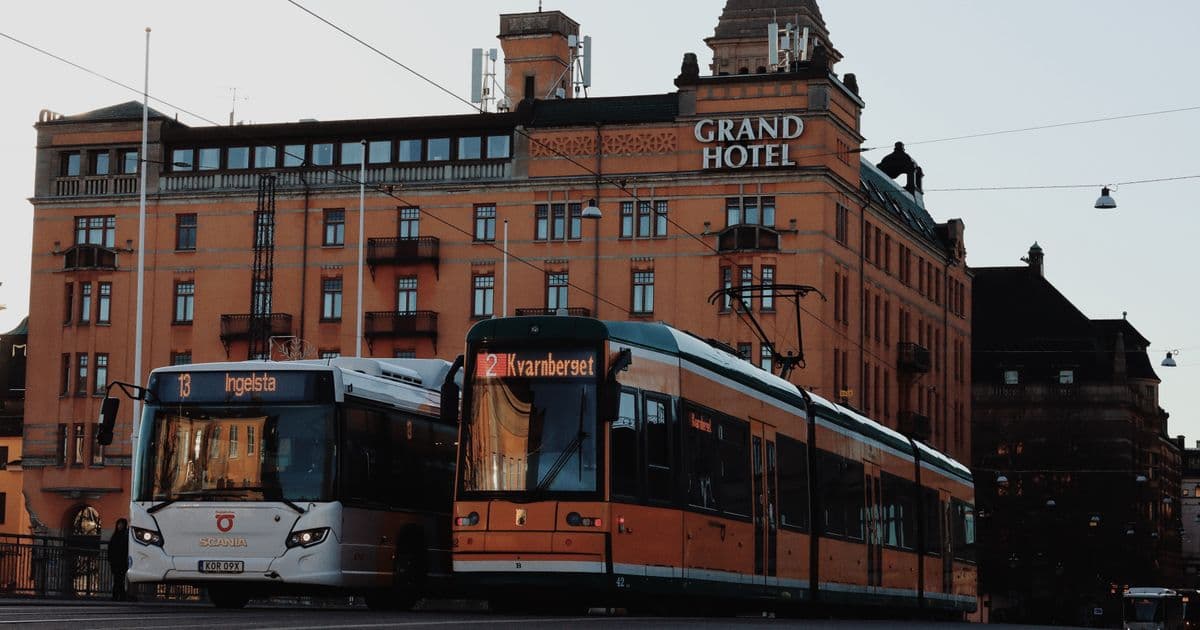
Waxholmsbolaget is the county-owned ferry operator serving both the archipelago and central Stockholm's harbor routes. From the city center, SL commuter boats and buses connect to the main Waxholmsbolaget terminals, most notably Strömkajen near the Grand Hotel. Ticket prices are zone-based rather than a single flat fare. Travelers island-hopping across several zones in one trip should check Waxholmsbolaget's own fares page before buying single tickets for each leg.
An SL period ticket valid for at least 30 days also rides free on Waxholmsbolaget's archipelago boats, but only during the low season, from mid-September to April, according to SL's official announcement of the arrangement. This is worth naming because it removes a separate ticket purchase for a traveler already holding a qualifying SL pass. The 30-day minimum and the seasonal window both apply: a short-stay SL ticket does not qualify, and the benefit does not extend into the summer high season.
Gotland: One Ferry Crossing Replaces the Car
Gotland is reached by a single ferry crossing, not a bridge, and a foot passenger needs no car on either end of the trip. Destination Gotland operates the year-round routes, sailing from both Nynäshamn and Oskarshamn to Visby, with Nynäshamn as the more direct option from Stockholm.
Reaching the Nynäshamn terminal from central Stockholm is straightforward by train, since the Nynäshamn commuter line connects directly into the city's rail network and terminates close to the ferry quay. The Nynäshamn–Visby crossing runs approximately 3 hours 15 minutes, per Destination Gotland's published schedule. That crossing time is the deciding number for whether a day trip from Stockholm is realistic, and most travelers treat Gotland as an overnight or multi-day visit rather than a same-day round trip.
Booking ahead matters most in peak summer season, when departures sell out well before the sailing date, according to Destination Gotland's own guidance. Outside of July and early August, foot-passenger space is generally easier to secure closer to the travel date, though vehicle spaces sell out faster than foot-passenger tickets year-round.
The Norrland Coast: Day Trains to Kiruna
The Norrland coast is not off the rail network. Norrtåg runs day trains connecting Luleå, Boden, and Kiruna, and a separate line linking Umeå to Luleå, both running independently of SJ's overnight service on the same corridor.
On the Luleå–Boden–Kiruna line, Norrtåg operates several day-train departures in each direction daily, according to the operator's published timetable pages. The exact count varies with the current seasonal schedule, so travelers should check Norrtåg's own timetable rather than rely on a fixed number. The Umeå–Boden–Luleå line runs on a steadier pattern, with up to three daily trains in each direction, per Norrtåg's route documentation.
These day services complement, rather than replace, the overnight SJ route along the same corridor. A traveler who wants to reach Kiruna during daylight hours, to see the landscape along the way, has that option on Norrtåg even when SJ's overnight train is the faster point-to-point choice. The two services are booked separately and do not share a combined ticket.
Sources: Destination Gotland published schedule (confirmed); Norrtåg timetable, en.norrtag.se/tidtabeller (typical range, varies by seasonal timetable).
The Far North Night Train: What Changed in 2026
From 13 April 2026, Trafikverket halved the Stockholm–Narvik night-train frequency to one daily round trip on both the Narvik and Umeå branches, according to reporting by Norran. The change followed years of ageing rolling stock and rising maintenance cost on the route, which runs some of the longest single train journeys in Europe.
Since 13 April 2026, the Narvik leg is no longer a single continuous train. Travelers now ride overnight from Stockholm to Boden, then change onto a separate day train for the remaining stretch on to Narvik. The Umeå branch has not been split in the same way and remains a direct route from Stockholm.
Behind the frequency cut sits an unresolved procurement problem. Trafikverket's initial 2026 retender for continued night-train operation past December 2026 drew bids that exceeded budget and had to be revised. The authority took on more of the rolling-stock risk itself, per Railway Gazette's 31 March 2026 reporting. The revised contract requires at least one daily round trip on both the Stockholm–Narvik and Stockholm–Umeå routes, setting a service floor while the operating arrangement past 2026 is finalized. SJ currently holds the route under a direct-award contract that runs until December 2026, the next milestone to watch for a longer-term agreement.
New rolling stock is already under contract but will not solve the near-term gap. Trafikverket selected Talgo as the supplier around 2 April 2026. Contract details published by Railway Gazette on 21 April 2026 put the deal at EUR 485 million, or roughly SEK 5.5 billion. The order covers ten Siemens Vectron locomotives and 91 Talgo coaches built to a minus-40°C cold-weather specification. Entry into service is planned for 2030, with the full fleet delivered by 2031 and Talgo maintaining the fleet for ten years under the contract. Railcolornews.com corroborated the supplier selection in its own 2 April 2026 reporting.
The Rule That Decides Whether a Region Needs a Car
The rule holds across every region covered here. Wherever a county-run rail or ferry authority operates a regular schedule, a car is optional; wherever that coverage thins to a single daily departure, planning around the timetable becomes mandatory. Skåne and central Sweden's dense, electrified regional rail makes a car genuinely unnecessary for most trips. The Stockholm archipelago and Gotland trade a car for a boat, with Waxholmsbolaget and Destination Gotland as the fixed points to book around. The Norrland coast holds up better than its reputation suggests, with Norrtåg's day trains reaching Kiruna independently of the overnight service. The one exception is the far-north night train itself, now reduced to a single daily round trip since April 2026, with the long-term operating contract still pending.
None of this changes how a traveler should choose where to go in Sweden in the first place; it only changes how that choice gets booked. For help with choosing which regions to visit, pair that decision with the transport constraints named above before setting an itinerary.
Frequently Asked Questions
Do you need to book the Gotland ferry in advance as a foot passenger?
Booking ahead is advisable in peak summer season, when departures sell out, per Destination Gotland's own guidance. Outside July and early August, foot-passenger space is typically easier to find closer to the sailing date.
Can an SL pass be used on Stockholm archipelago boats?
Yes, with a condition. An SL period ticket valid for at least 30 days also covers Waxholmsbolaget's archipelago boats, but only during the low season, from mid-September to April, per SL's official announcement.
Has anything changed recently for train travel to the far north?
Yes. The Stockholm–Narvik night-train frequency was halved to one daily round trip from 13 April 2026, per Trafikverket, and the follow-on contract past December 2026 was still being finalized as of this article.
Is the Norrland coast reachable without an overnight train?
Yes. Norrtåg's day trains connect Luleå, Boden, and Kiruna, and separately link Umeå and Luleå, on a schedule that runs independently of SJ's overnight service.